The pod doors hissed open, ejecting Wesley and dozens of other candidates onto cold metal flooring. They gasped for air, disoriented, the injection still burning through their veins.
Guards in white jumpsuits herded them through corridors. None of the guards spoke. One of them was eating a sandwich while he herded, and somehow that was worse than if he had been shouting. They reached a room filled with rows of computer terminals.
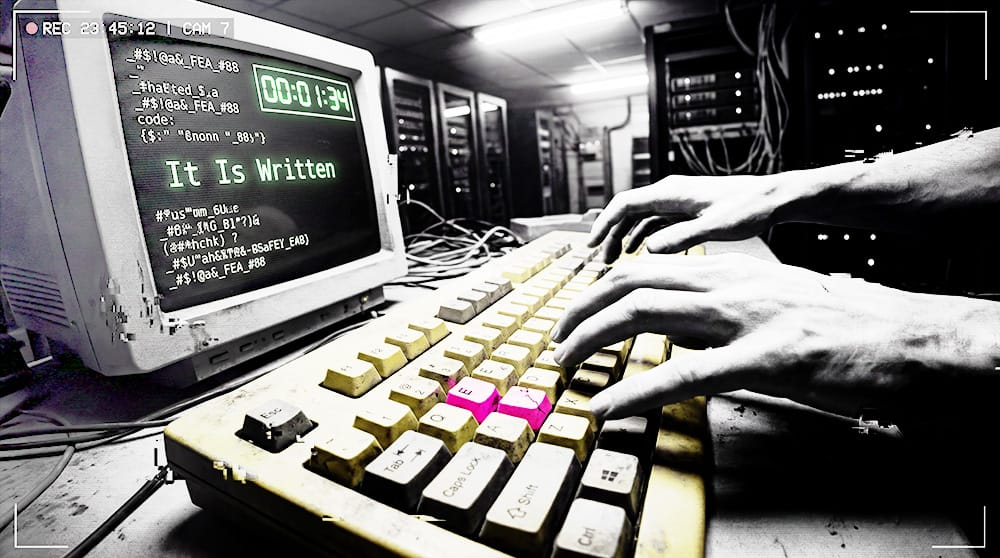
Wesley found an empty seat. The screen before him displayed three words in bold letters: It Is Written.
The terminal was ancient. Keys yellowed from decades of use. Screen flickering with occasional static. He ran his fingers across the keyboard. Twenty-six letters, twelve function keys, and a spacebar worn smooth in the center from thousands of nervous thumbs. The spacebar didn’t work. Except when it did, which was worse, because then it stuck for forty-two characters and the gaps between words made your eyes drift apart like magnets repelling. The ‘E’ was gone entirely. Somebody, at some point, had replaced it with a chip of pink plastic that did not match anything else in the room.
Wonderful. His entire future decided by a machine that looked older than his father.
“Begin,” the woman’s voice commanded.
Wesley’s fingers flew across the keyboard. Mathematical equations. Ethical scenarios. Problem-solving puzzles. Logic tests. The timer in the corner counted down relentlessly.
Question 1: “A colleague takes credit for your work. Do you confront them or report to a supervisor?”
Wesley typed: I would calmly address the situation directly.
The spacebar stuck. What appeared on screen: I would calmlyaddressthesituationdirectly.
He backspaced. Tried again. The spacebar unstuck with enthusiasm: I would calmly address the situation directly.
Thirty-seven spaces. He looked like he’d had a stroke mid-sentence.
Question 7: “Describe your greatest strength.”
I am good at fixing things, he typed.
Output: Iamgoodatfixingthings.
He jabbed the spacebar. Nothing. Jabbed harder. Still nothing. Slammed it with his palm.
Iamgoodatfixingthings .
The period now lived in a different postal code from the rest of the sentence.
Question 12: “If resources are limited, who should receive priority: the young or the elderly?”
A genuinely difficult ethical question. Wesley considered his response carefully. Typed thoughtfully.
The young have more years to contribute but the elderly have earned their rest so we should find abalancedapproach.
The spacebar had chosen violence today.
Question 19: “Complete the following: ‘The purpose of work is to...’”
Serve the collective good.
Output: Servethecollectivegood.
He fixed it: Serve the collective good.
The screen displayed: Serve the collective goo d.
Now it looked like he was advocating for some kind of communal slime. Fantastic.
No pressure. Just his entire life hanging in the balance.
Between questions, his thoughts drifted unbidden to his hidden room. To the empty space where Roz had stood. Who had taken her? When? How?
The timer kept counting down. Indifferent to his loss.
The screen flickered with new questions: “Do you prefer to scavenge for resources on your own or work with a group?”
“If you could have any item from the past, what would it be and why?”
Wesley stared. Both answers he wanted to give would get him Recycled by dinner. He picked the third most honest thing he could think of, which was a better screwdriver, and moved on.
The spacebar had other plans: abetterscrewdriver.
He fixed it. The spacebar overcorrected: a better screw driver.
Now he wanted a driver named Screw. Or possibly a screw that could drive. Either way, he was not getting extra points for clarity.
Question 31: “Do you believe the Partisant has your best interests at heart?”
A trap. Obviously a trap. Wesley typed the only safe answer: Yes, absolutely.
The screen displayed: Yesabsolutely.
He tried to add the space. The key didn’t respond. He pressed harder. Nothing. He leaned his entire body weight onto the spacebar.
Yes absolutely.
The hesitation was now visible from orbit. If the Partisant was monitoring for loyalty, Wesley had just typed the visual equivalent of “Yes... [nervous sweating] ...absolutely.”
He left it. The timer wasn’t going to wait for keyboard therapy.
Then the questions shifted. They became... personal.
“How would you describe your relationship with your parents?”
Wesley’s fingers hovered over the keys. Distant, he typed. Functional but distant.
“How many close friends do you have? List their names.”
He stared at the blinking cursor. Riven. Just Riven. And she was already in the testing room elsewhere.
“If you disappeared tomorrow, how many people would actively search for you?”
Wesley’s breath caught.
Well. That was a cheerful question. His father would file a report, eventually. His mother, if she were still alive, would have torn the Stacks apart. His aunt would have burnt his torn jeans and celebrate… But now?
He typed the honest answer: One. Maybe.
“Would you describe yourself as... attached to this Stack?”
No, Wesley typed, and the honesty of it burned.
“Do you dream? If yes, describe your most recent dream in detail.”
His hands froze over the keyboard. Dreams were a Treatment violation. Reporting them was dangerous. But this was the Beta Test. Surely they expected compliance?
He thought of the image in the pod. His mother’s face, white and cold, eyes closed. Had that been a dream? It had been something more. Something the Cell frequency couldn’t quite suppress.
[ENCRYPTED:Her face, white and cold.]
No, he typed. I have never dreamed.
The spacebar, sensing the gravity of the moment, chose to cooperate perfectly. Typical. Forty-six questions of keyboard chaos, but for the one answer that could get him killed, pristine formatting.
The lie felt necessary. But also dangerous.
The screen accepted his answers without comment. Wesley’s stomach clenched. These weren’t aptitude questions.
They were measuring something else entirely.
How easily he could vanish. How few people would notice. How unattached he was to the world that had made him.
A dark thought surfaced: what if the Beta Test wasn’t about finding the best candidates for jobs? What if it was about finding the best candidates for something else? Something that required people who wouldn’t be missed?
The timer chimed.
Wesley stared at his unfinished work. Forty-seven questions done. Forty-three still blank. Of the forty-seven, maybe twelve were legible. The rest looked like they’d been typed by someone having a medical event while falling down stairs.
At least he wouldn’t have to explain the blank answers. Or the ones where he’d accidentally typed therapist without a space.
Then the floor vanished.