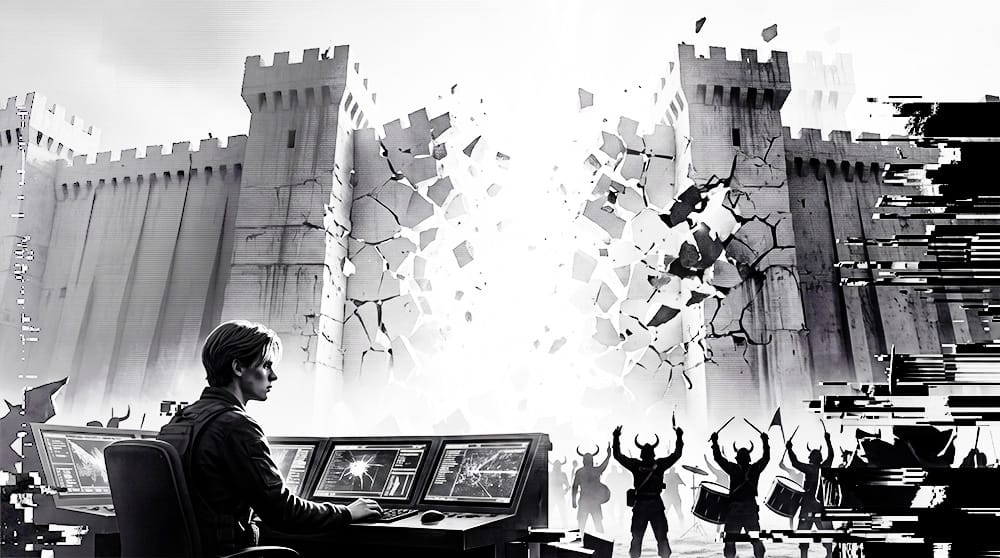
The candidates were led into a circular chamber ringed with tactical displays. Each station showed a different military scenario: armies, fortifications, siege weapons rendered in glowing simulations.
One by one, candidates stepped forward to face their scenarios. Wesley watched them make split-second decisions, their digital armies clashing in battles that lasted less than a minute. Some won. Some lost. None seemed to understand what they were being tested for.
The kid before Wesley tried to bribe the walls with in-game currency. The simulation’s response: “FORTIFICATIONS DO NOT ACCEPT CREDITS. WALLS HAVE NO POCKETS.”
Before that, a girl had commanded her army to politely knock and request entry. “DIPLOMACY REJECTED. ENEMY MORALE: AMUSED. ENEMY HAS BEGUN LAUGHING. ENEMY LAUGHTER ECHOING OFF WALLS YOU CANNOT BREACH.”
And before her, a red-faced boy had simply stood there, arms crossed, while his army milled around uselessly. After forty-five seconds of nothing, he’d screamed “THIS IS RIGGED” and had to be escorted out by two guards. His digital army watched him go with what Wesley could only describe as relief.
At the station to Wesley’s right, the ping-pong kid from the gravity test was somehow winning. His hands slammed random buttons in a panic. His cavalry charged into a river and drowned. The simulation auto-corrected them into amphibious units. His archers fired backwards. The arrows curved mid-flight and struck enemy commanders. He accidentally deleted his own general. The simulation promoted a horse to replace him. The horse was doing an excellent job.
The kid looked absolutely terrified. His score: inexplicably perfect.
Wesley was next.
“Scenario 14-C,” the voice announced, with the flat courtesy of a machine that had delivered this exact sentence to eight hundred candidates before lunch. “War has led your people to a fortified city. Your enemy is inside. What do you do, candidate?”
Wesley’s eyes swept over the simulation. His army was outnumbered, poorly equipped, and standing before walls that towered impossibly high. No siege weapons. No battering rams. No explosives. Just bodies and he could hear their voices in the simulator.
“What is my goal?” Wesley asked.
“Breach the fortification. Eliminate the barrier.”
Breach the fortification. With what? Harsh language? The last simulation had them laser-dueling in zero gravity. This one issued his army towels, sandals, and what looked like the Partisant’s apology for not including a ladder.
Wesley ran through options.
Siege towers? None available. Battering rams? His inventory showed nothing. Tunneling? The simulation clock wouldn’t allow it. Catapults? No materials.
He had no siege weapons. No explosives. Just a digital army that looked about as threatening as a group of lost tourists.
This made no sense.
Think. Think. There had to be something.
He tried stacking his soldiers into a human pyramid. The simulation rejected it. “INVALID FORMATION.”
What about infiltration? He selected his smallest soldier and tried to have him squeeze through the drainage grate at the base of the wall. “ACCESS DENIED. GRATE CLEARANCE 4.2 CENTIMETERS. SOLDIER WIDTH 19. RECOMMEND LARGER GRATE OR SMALLER SOLDIER.”
The grate was too small for the smallest soldier. Great. Very helpful.
He tried having his army sing so badly that the enemy would surrender out of pity. “MORALE EFFECT: NONE.”
He tried intimidation, having his troops make scary faces at the walls. “FORTIFICATION UNAFFECTED.”
He tried waiting for the walls to get tired and fall down on their own. “STRATEGY LOGGED: PASSIVE ATTRITION. HISTORICAL SUCCESS RATE: ZERO. TIME LIMIT EXCEEDED IN 3... 2...”
Okay, that wasn’t going to work either.
This made no sense. The simulation was impossible. Unless it wasn’t testing tactics at all. Unless it was testing something else entirely.
An impossible memory surfaced. His mother’s voice, whispering a story he’d half-forgotten. Walls that fell not to force but to faith. Days of marching and a shout that shook the world.
It was insane. It was probably wrong. It definitely shouldn’t work in any reasonable military simulation.
But it was all he had.
“My army lacks the physical power to bring down these walls,” Wesley said, the strategy forming as he spoke. “So we march. Around them. For seven days. Then...”
The simulation flickered. “STRATEGY NOT FOUND IN DATABASE.”
He paused, the memory crystallizing.
“Then we unleash every sound we can make. Horns. Drums. Voices. My troops will shout as one, and the walls will fall.”
“SEARCHING... SEARCHING... NO RESULTS.”
A longer pause.
“SEARCHING EXPANDED ARCHIVES... NO RESULTS.”
“SEARCHING PRE-PARTITION RECORDS... ACCESS RESTRICTED... OVERRIDE REQUESTED FROM SUPERVISOR.”
“SUPERVISOR UNAVAILABLE.”
“PROCEEDING ANYWAY.”
Silence.
His brain screamed objections. This was stupid. This was the stupidest answer anyone had ever given in the history of military simulations. They were going to fail him. They were going to...
The simulation flickered. His digital army circled the city, their footsteps rhythmic, relentless. Day after day, the march continued.
On the seventh circuit of the seventh day, they stopped. Raised their instruments. Opened their mouths.
The walls crumbled.
A blinding white light erupted from the rubble, the simulation dissolving into static.
Then: “Well done.”
Wesley was escorted out before he could see the other candidates’ reactions. But their stares pressed against his back. Whispers began.
He didn’t understand why the strategy had worked. March around walls for seven days and then shout at them? That shouldn’t work. That shouldn’t work in any reasonable simulation.
But it had come from somewhere deeper than tactics. Somewhere his mother’s forbidden stories still lived.
[ENCRYPTED:She called them the walls of Jericho.]
Maybe the test wasn’t measuring what he thought it was measuring.